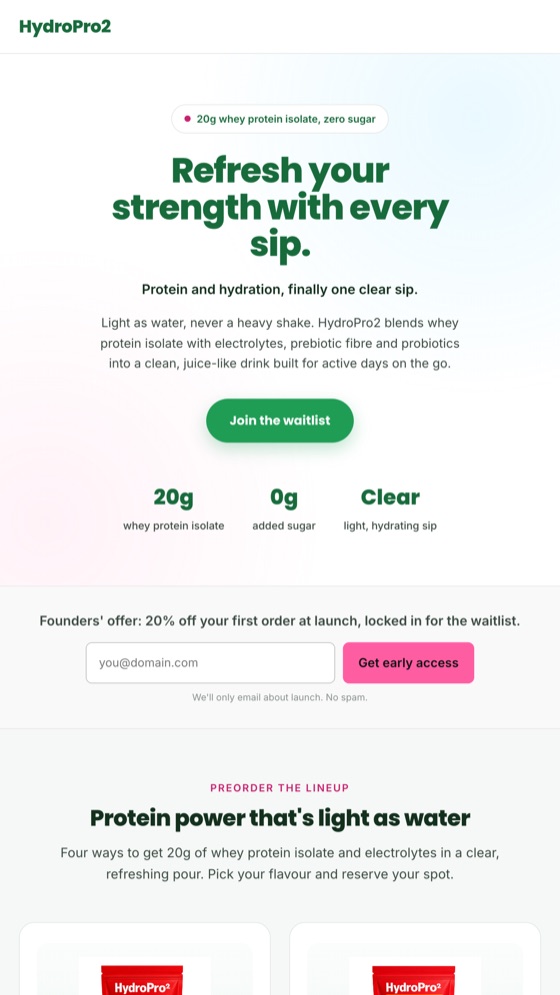
Starting from scratch

A brand-new product, tested in days.

Point Relay at a product nobody has tested yet. It builds a tailored page and ad for every audience worth trying, launches each one small, and reads which audiences actually convert before you commit real budget. From a product name to a complete in-market test in about two days, with no one building it by hand.

Clear protein drink · pre-launch · two variantsLive early results
79waitlist signups
$10.60average cost per signup
$838spent so far
Variant A vs B
Product A Wins $9.79
Product B $11.48
Cheapest audiences found, cost per signup
Organic food3 signups
$6
Athleisure shoppers19 signups
$7
Whey concentrate21 signups
$8
Two audiences cutran above target, paused on confidence
$17

17 pages and 17 ads, built in two days across 2 product variants and about 10 audiences.

Product name to in-market
~0days
Pages, ads and campaigns, live. Nothing built by hand.
Starting budget per audience
0to $15 a day
Each audience opens narrow, at the cost the model predicted.
Best cost per signup found
0
From the right audience. The wrong ones ran at $17 and were cut.
Decided in the test
Avs B
Which variant to launch, and to whom, before a full launch.
A live test

Two products, one weekend.

Both started from a product name and a bag render. Relay wrote the pages and the ads, opened an audience at a time, and had signup costs by audience within days. The outcome here is a waitlist signup because neither product had shipped yet; for a shipping product it is the purchase.
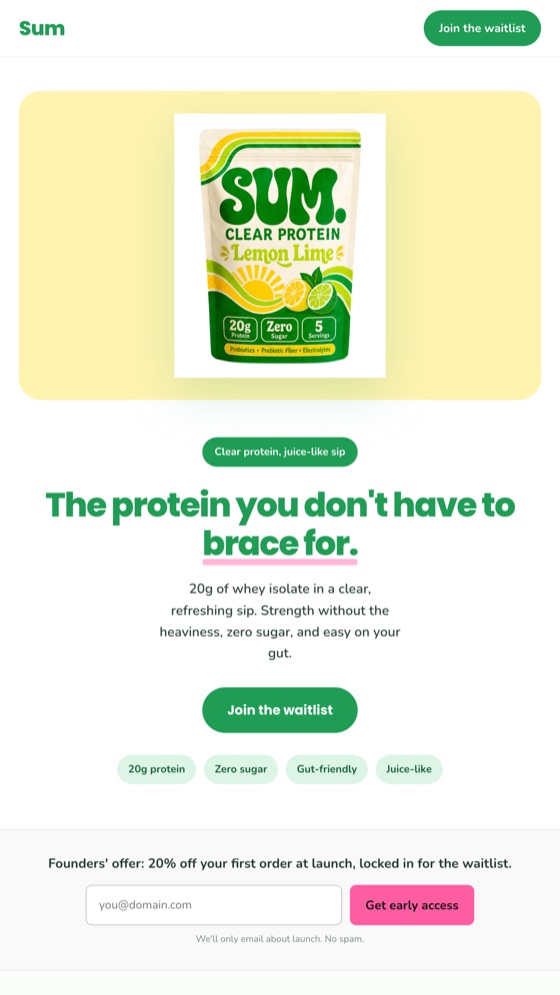
Clear protein, lemon lime

Page and ad per audience · 17 built · outcome: waitlist signup
Organic food3 signups
$6
Athleisure shoppers19 signups
$7
Whey concentrate21 signups
$8

Protein and hydration, orange

Page and ad per audience · 14 built · outcome: waitlist signup
Vitamins and supplements14 signups
$5
Electrolyte drinkers18 signups
$7
Sports drink16 signups
$8
How a test runs

Audiences are the unit, not ads.

01

Every audience worth trying

The model ranks every untested interest, demographic and location by predicted cost per outcome, from your category and whatever history exists. The ones worth trying each get their own narrow campaign at $10 to $15 a day.

02

A page and an ad per audience

Each audience gets an on-brand ad and a landing page written for that exact buyer, scored by the model before a dollar is spent. If you have two product variants, both get tested against each audience.

03

Kill or scale, on confidence

Every audience starts at its model-predicted cost. Real signups or purchases move it. The model cuts an audience only when it is statistically sure it is above target, and scales it when it is sure it is below.

Why this matters

Find the demand for the price of a small test.

Not a full launch. A few hundred dollars across ten audiences tells you which ones buy and at what cost. The model scales those, cuts the ones that ran at $17, and every result trains the predictor, so the next round starts at a lower predicted cost. The winning audiences become the first buyer profiles in your model, and the B2C path picks up from there.
On-brand ads the same engine generated for live brandsno designer, no copywriter
Gut-health supplementSuu
Protein bar, by stateGutsy
Snack, young adultsDAAL

Give us a product name.

Tell us the product, the price, and what you already know. We come back in about two days with the pages, the ads and the first audiences, live, and signup or purchase costs by audience within the week.

iSmall to start. Each audience opens at $10 to $15 a day. You see the cost per outcome before anything is scaled.
iiPre-launch works. If the product has not shipped, the outcome is a waitlist signup and the page carries a founders' offer.
iiiFirst-party from day one. The tracking snippet goes in with the pages, so every signup or purchase is tied to its audience and ad.